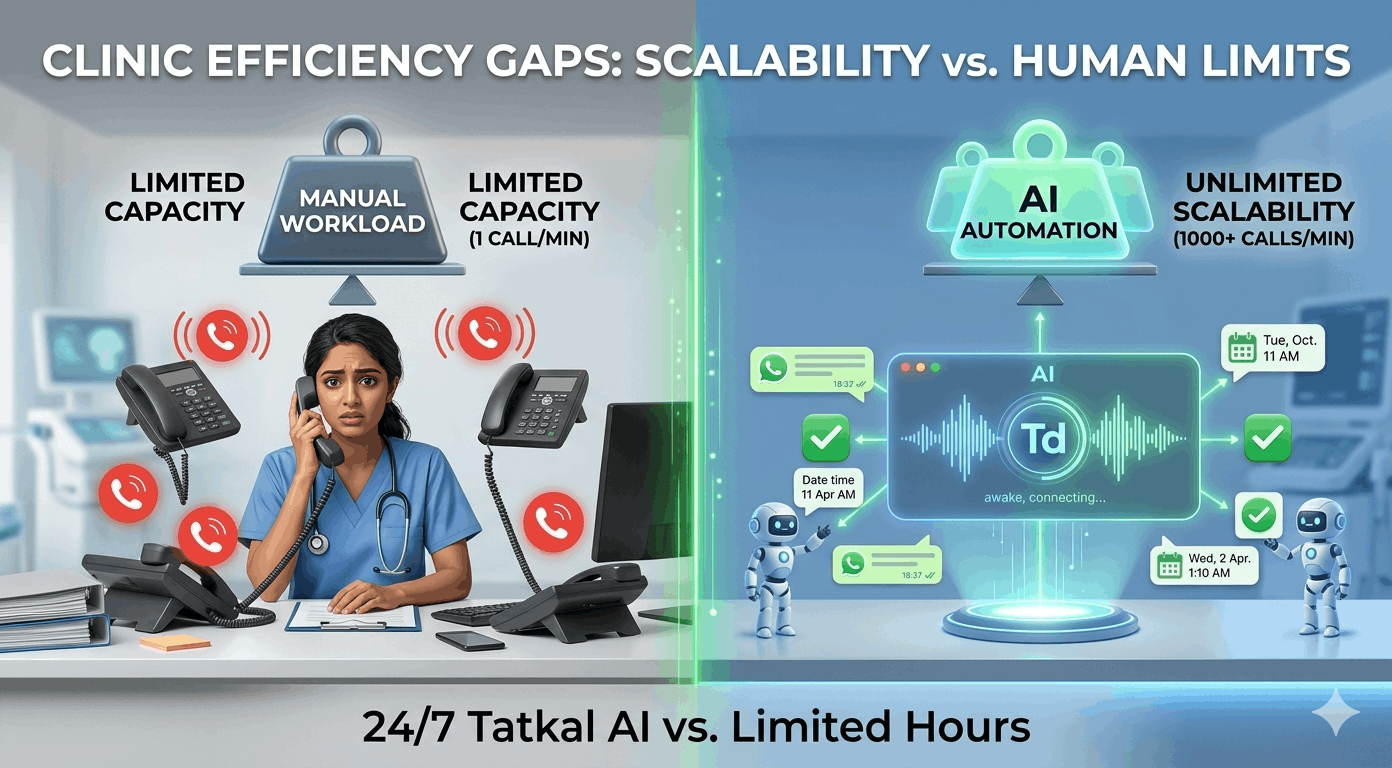
Managing patient calls efficiently has become one of the
biggest operational challenges for clinics. Missed calls often translate into
missed appointments, and delayed responses can push patients toward
competitors. This is where solutions like automated call answering for
clinics are gaining attention. Platforms like Tatkal Doctor helping
clinics rethink how they handle incoming calls by introducing AI-driven systems
that work continuously without fatigue or delays.
The comparison between a traditional receptionist and an AI
phone answering service healthcare system is not just about cost it’s about
consistency, scalability, and patient experience. Clinics today need to decide
which approach truly supports their growth.
Understanding the Role of a Receptionist
A receptionist has always been the first point of contact in
a clinic. They answer calls, schedule appointments, and guide patients. Human
interaction brings warmth, and in many cases, patients feel more comfortable
speaking to a person.
However, real-world challenges often limit effectiveness.
Receptionists can handle only one call at a time. During peak hours, calls go
unanswered or are rushed. Even the most efficient staff can miss details when
multitasking.
There’s also dependency. If the receptionist is absent or
overwhelmed, the entire communication flow is affected. This creates
inconsistency in service, something patients notice immediately.
How AI Voice Calling is Changing Clinic Operations
An AI voice calling for clinics system works
differently. It doesn’t get busy, tired, or distracted. It answers every call
instantly, whether it’s the first call of the day or the hundredth.
With an AI voice assistant for doctors, clinics can
automate tasks like:
- Appointment
booking
- Call
routing
- Basic
patient queries
- Appointment
confirmations and reminders
The system responds in real-time, ensuring that no patient
feels ignored. Unlike manual handling, it can manage multiple calls
simultaneously without compromising accuracy.
Speed and Availability: A Clear Difference
Speed is often the deciding factor for patients. If a call
is not answered within a few seconds, they tend to disconnect.
A receptionist can unintentionally miss calls during busy
hours. In contrast, an AI phone answering service healthcare solution
ensures immediate response every time. It operates 24/7, which means even after
clinic hours, patients can book appointments or get information.
This level of availability creates a strong first impression
and improves trust.
Handling High Call Volume Without Stress
Clinics with growing patient numbers often struggle with
call overload. Managing dozens of calls within a short time frame is not easy
for any human team.
Here’s where automated call answering for clinics
proves its value:
- Multiple
calls handled at once
- No
waiting time for patients
- Consistent
communication quality
This doesn’t just improve efficiency it reduces stress for
clinic staff and creates a smoother workflow.
Accuracy and Consistency in Communication
Human errors are natural. A receptionist might mishear a
time slot or forget to note down patient details correctly.
An AI voice assistant for doctors eliminates such
inconsistencies. It follows predefined logic, captures information accurately,
and ensures that every appointment is recorded correctly.
Consistency becomes a major advantage here. Every patient
receives the same level of attention and clarity, regardless of timing or call
volume.
Cost vs Value: What Clinics Should Consider
At first glance, hiring a receptionist may seem like a
straightforward solution. However, the actual cost includes salary, training,
leaves, and operational dependency.
On the other hand, an AI voice calling for clinics
system is a one-time setup with predictable operational costs. It scales with
your clinic’s growth without requiring additional manpower.
The real question is not which is cheaper, but which
delivers better long-term value.
Where Human Receptionists Still Matter
Despite the advantages of AI, human receptionists still have
their place.
Certain situations require empathy and nuanced
understanding, such as:
- Handling
sensitive patient concerns
- Managing
complex conversations
- Dealing
with exceptional cases
In such scenarios, a human touch can make a difference. The
ideal approach is not to replace humans completely but to reduce their workload
and allow them to focus on what truly needs human attention.
The Hybrid Model: Best of Both Worlds
Many modern clinics are moving toward a hybrid system.
Routine tasks are handled by an AI phone answering
service healthcare solution, while human staff manage more complex
interactions. This creates a balanced workflow where efficiency and empathy
coexist.
With solutions like Tatkal Doctor, clinics can
implement this hybrid approach without complexity. Tatkal Doctor provide
systems that integrate AI with existing clinic operations, ensuring a smooth
transition.
Practical Comparison
Here’s a simple way to understand the difference:
Receptionist
- Handles
one call at a time
- Limited
to working hours
- Prone
to human errors
- Requires
ongoing management
AI Voice Calling
- Handles
multiple calls simultaneously
- Available
24/7
- Consistent
and accurate
- Scales
without extra cost
This comparison highlights why many clinics are gradually
shifting toward AI-driven systems.
Impact on Patient Experience
From a patient’s perspective, convenience matters the most.
When calls are answered instantly and appointments are
booked without delay, it creates a positive experience. Patients don’t have to
wait, repeat information, or deal with confusion.
An AI voice assistant for doctors ensures that every
interaction is smooth and predictable. This builds trust and encourages repeat
visits.
Key Takeaways for Clinic Owners
- Missed
calls directly impact revenue and patient trust
- Automation
improves response time and efficiency
- AI
systems reduce dependency on staff for routine tasks
- A
hybrid model offers the best balance between technology and human
interaction
Choosing between AI and a receptionist is not about
eliminating one it’s about optimizing your clinic’s operations.
Final Thoughts
Clinics that rely only on traditional methods may find it
difficult to keep up with increasing patient expectations. Speed, accuracy, and
availability are no longer optional—they are expected.
An AI voice calling for clinics solution brings
consistency and scalability, while human staff provide empathy where needed.
Together, they create a system that is both efficient and patient-friendly.
Solutions like Tatkal Doctor already helping clinics
move in this direction. By adopting smarter communication systems, clinics can
focus more on patient care and less on operational challenges.